


After more than a decade, the College is reintroducing upward evaluation, giving employees a structured, meaningful way to share responses with their managers. The move is a direct result of recommendations by the Theory of Change’s Demonstrated Practices of Caring design team. Upward Evaluation is a similar practice to course evaluation; managers (anyone who supervises one or more team members) will now hear from their team members like our faculty hear from their students, and eventually, come to use those results as part of their annual performance evaluation.
This process is designed to strengthen communication, support leadership growth, and ensure every voice helps shape how we work together. Done well, this process leads to better understanding, better decisions, and a better workplace.
FY26: Baseline Year
FY26 is a baseline year for the project. All ACC employees will be invited to participate in completing a questionnaire about their primary manager. All managers will receive results, but Cabinet members and their direct reports who have participated in the Chancellor’s Leadership Instititute (CLI) will test the full process, up to and including their UE results, in their formal Performance Excellence Program (PEP) evaluations. All other managers will learn how to interpret their results and write action plans for their teams. Their results will not be included in this year’s PEP.
How it works
- You’ll receive an email containing a link for evaluating your manager.
- Your responses, focusing on your interactions with your manager, will be submitted confidentially
- Managers who have 5 or more participants will receive personalized reports; those with fewer than 5 participants will have their data included in their next-level manager’s results.
- Responses are compiled and aggregated to protect confidentiality
- Managers receive results and use them to identify areas of strength and growth.
Timeline
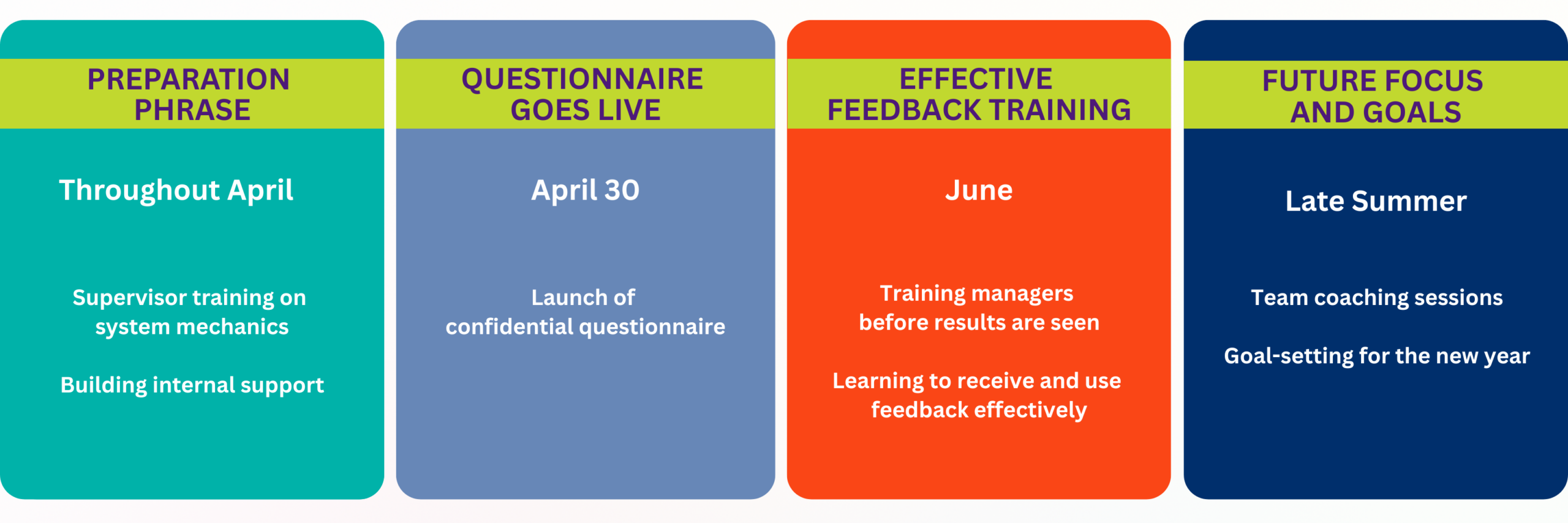
What happens next
This is where upward evaluations lead to action. Managers will discuss their results with their supervising manager, then create action and communication plans that they will share with their direct reports in late summer and early fall.
Participation and Confidentiality
- Participation is strongly encouraged.
- Responses are confidential.
- Managers will receive only aggregated and de-identified data in their results.
Values-Based Behaviors at the Heart of Upward Evaluation
Managers will be evaluated according to newly identified Values-Based Behaviors (VBB). This framework turns our values into real-world action and provides a map for how we all treat each other.
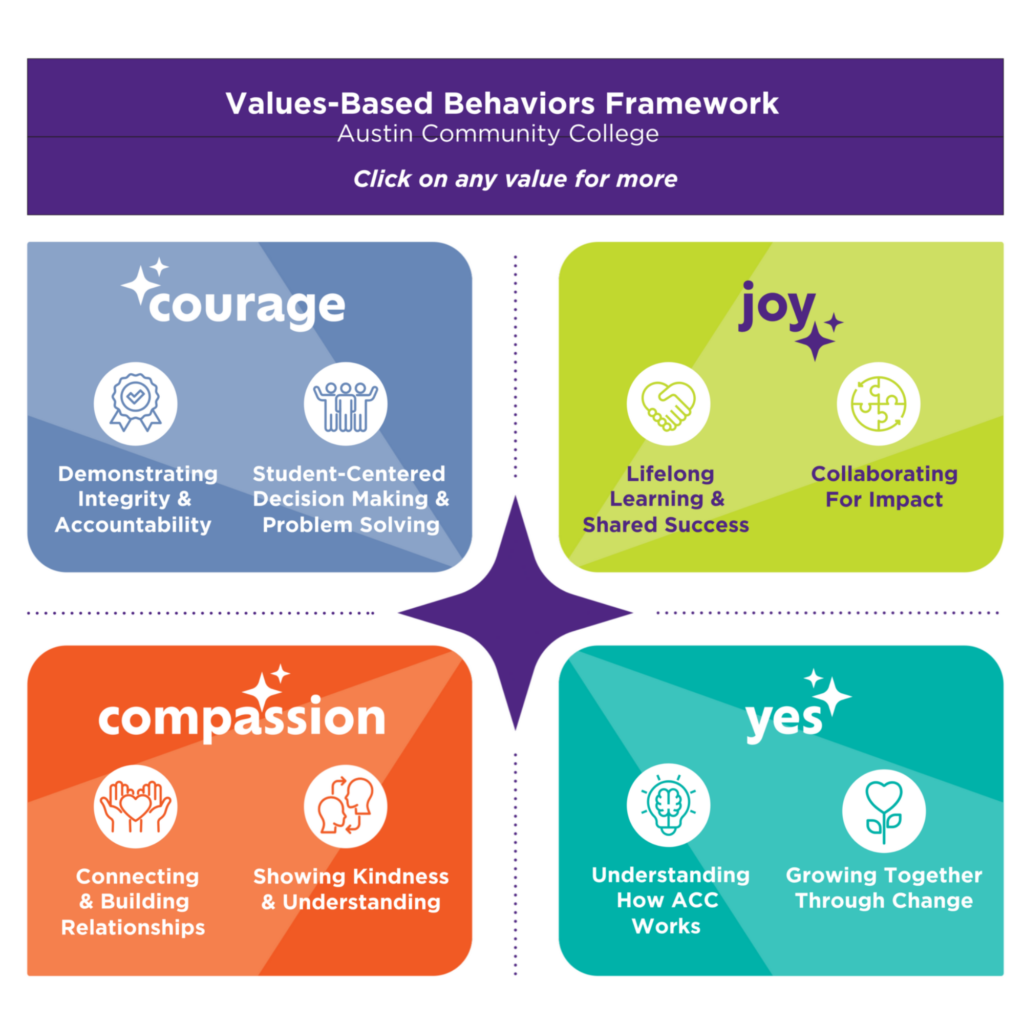
Values-Based Behaviors translate ACC’s values — Courage, Compassion, Joy, and Yes — into clear, observable actions that guide how we work with students and one another. These competencies are designed to support a shared culture across the college and will be integrated into programming, training, and employee development.
A competency is a measurable combination of knowledge, skills, and behaviors that enables effective performance in a job. A behavior is the observable, specific action or action pattern a person exhibits in a given situation. Simply put: Competency is what you can do, while behavior is how you do it.
The behaviors under each competency are broken out by role type at the college: Teacher, Helper, and Manager. Note that an employee at the college may have more than one role at the same time. For example, there are times when a Manager is also a Teacher, or is also a Helper. Additionally, there may be times when you become another role. For example, a Helper becomes a Teacher, or vice versa. These roles are broken out to help you understand the expectations of that role when serving our Riverbats.
Teacher
Employee who teaches students and/or other employees in a classroom-style setting
Helper
Employee who provides services to students and/or other employees outside of a classroom-style setting
Manager
Teacher/helper who manages other teachers/helpers
Get more insight into the value of Upward Evaluation in Vice Chancellor Kelly Torrico’s recent HappyHR newsletter.
Explore the competencies, resources, and FAQs below to learn how VBB comes to life in your role.
Upward Evaluation FAQ
Q: I didn't receive an email about the Upward Evaluation. What should I do?
A: Please check your spam or junk folder first. Look for an email with the subject line “Submit your 2026 Upward Evaluation.” If you still can’t find it, please submit a TDX ticket or contact your HR Business Partner.
A. Upward Evaluation is a structured process that gives employees the opportunity to provide feedback to their managers. It is designed to support reflection, strengthen leadership practices, and improve the overall employee experience.
Q: Why is ACC introducing Upward Evaluation?
A: This initiative grew directly out of our Theory of Change (ToC) and Demonstrated Practices of Caring (DPOC) work to establish consistent management practices across the college. The goal is to create a measurable framework that recognizes strong leadership and builds our collective capacity. By focusing on specific practices rather than people, we can provide professional development that meets the actual needs of our teams.
Q: How does this align with our college values?
A: The entire framework is built on our core values: Courage, Compassion, Joy, and Yes. It turns these values into observable behaviors — like leading with the “why” behind decisions or addressing difficult conversations directly and kindly.
Q: What is the benefit of participating?
A: This is your opportunity to help shape the way we work at ACC. Your participation ensures we don’t work in a vacuum. By sharing results with managers and circling back to teams, we make sure everyone is on the same page and knows they’re being heard.
Q: I’m getting an error when I try the SSO option. What should I do?
A: Do not use SSO. Sign in via the standard Qualtrics login using the credentials provided in your invitation email.
Q: Is the survey safe and confidential?
A: Yes. Just like student course evaluations, the UE process is confidential and secure. No personally identifying information is provided to the managers being evaluated.
Q: How is the survey confidential if it is tied to a unique link or my name?
A: Your unique link was randomly generated and ensures that everyone submits only one evaluation. Your email and name are never recorded within the questionnaire data. Managers see only a de-identified, summary-level view of the team’s feedback. To further protect your privacy, results are never generated for teams with fewer than five participants.
Q: What does the evaluation look like?
A: It is a behavioral questionnaire using a 5-point Likert scale. You aren’t asked to rate your leader as a person, but rather to share your perception of behaviors you have observed firsthand — things you have seen and heard in the workplace. You can take a look at the questionnaire here.
Q: I didn't receive an email about the Upward Evaluation. What should I do?
A: Please check your spam or junk folder first. Look for an email with the subject line “Submit your 2026 Upward Evaluation.” If you still can’t find it, please submit a TDX ticket or contact your HR Business Partner.
Q: Can I save my progress and finish the evaluation later?
A: Yes! The survey link saves your progress as you go. You can close the window and relaunch the evaluation at any time until you click the final NEXT button.
Q: What areas are being evaluated?
A: The design framework covers 13 domains of effective leadership, including:
- Values-Based Leadership and Demonstrated Practices of Caring
- Building and Leading High-Performing Teams
- Innovation, Change Management, and Improvement
- Performance and Learning (Coaching and Career Planning)
Cabinet 360 Evaluations: To foster leadership development at every level, the ACC Cabinet will also complete a 360 evaluation process aligned with leadership domains. This year’s 360 model is targeted specifically at cabinet leadership; it is not collegewide.
Q: Which managers are participating this year?
A: For the FY 2026 Baseline year, all managers are included in data collection.
- The PEP Test Group: Cabinet members and their direct reports who have participated in the Chancellor’s Leadership Instititute (CLI) will test the process by using their UE results in their formal Performance Excellence Program (PEP) evaluations.
- All Other Managers: Will learn how to interpret their results and write action plans for their teams. Their results will be not be included in this year’s PEP.
A: No. Manager feedback will not be ignored. While Upward Evaluation results will not be formally recorded as part of PEP this year, managers will still meet with their managers to review feedback —including areas of concern — and receive coaching. Managers can still address significant issues and support improvement through ongoing coaching and performance conversations.
Q: Where can I get my questions answered?
A: For personal assistance, you can reach out to:
- Kelly Torrico, VC for Human Resources
- Office Hours: Fridays 3:30 – 4:30 p.m. via Zoom
- Our dedicated TDX Ticketing System
- HR phone – 512-223-7572
- HR Business Partners:
- Erica Breedlove – 512-738-2690
- Donald Jackson – 737-733-2522
- Aly Wang – 737-232-0973
- Learn more at the Demonstrated Practices of Caring Roadshow April 24, 10 a.m., HLC Board Room
Q: My team is getting a new manager this week. Can I evaluate my director instead?
A. Unfortunately, you’ll only be able to evaluate the manager assigned to you at the time of the launch. If you or your manager have recently transitioned, we simply ask that you share your perspective based on your experience to date.
Q: May I also evaluate leadership levels above my direct manager?
A: Upward evaluation is just one part of a process that will eventually include holistic 360 evaluation: self, supervising manager, peer, and reporting team evaluations. Your direct input will always be focused on your primary day-to-day manager in this process. If you have broader feedback to share about indirect levels of leadership at the college, your overall experiences, or divisional or organizational culture, the culture and climate survey will be available in the fall and will include questions that address these areas as well as open-ended questions.
Q: How can I access a device to take the survey?
A: Complete the survey on any device—it’s mobile-friendly! If you need access to a computer or tablet to participate, please reach out to your supervisor or HR for help.
Q: I manage employees who need access to a device to fill out the evaluation. How can I do this?
A: We can arrange technology access for your team. Please submit a TDX ticket or contact your HR Business Partner to coordinate.
Q: As a manager, how can I encourage my employees to participate?
A: Consider these options to support your team:
- Provide dedicated time: Set aside 15 minutes during a team meeting or stand-up.
- Create a “No Meeting” block: Schedule a 30-minute window during the evaluation period to allow everyone time to focus.
Values-Based Behaviors FAQ
A. The VBB is a clear roadmap that turns our abstract core values — Courage, Compassion, Joy, and Yes — into specific, actionable daily behaviors. It provides a shared language for how we treat one another and our students, moving us from just talking about values to consistently practicing them.
Q: Why do we need this now, and how does it help me?
A. Our community asked for clarity on what “living our values” actually looks like. This framework, rooted in the DPOC research, reduces runaround and ambiguity. Whether you are a Teacher, Helper, or Manager, you now have a tailored set of behaviors that define excellence in your specific context, creating a more predictable and supportive workplace for everyone.
Q: How are the roles in the matrix defined?
A. To make the behaviors relevant to your daily work, the framework categorizes roles into three groups:
- The Teacher: Anyone who instructs students or employees in a classroom or lab setting.
- The Helper: Anyone providing services or support to students or employees outside of a classroom.
- The Manager: A teacher or helper who also formally manages other staff members.
Q: What are the core pillars of these behaviors?
A. The behaviors are organized under our four core values to ensure we are all pulling in the same direction:
- Courage: Focusing on Integrity (doing what’s right) and Student-Centered Decision Making
- Compassion: Prioritizing Relationship Building and Showing Kindness
- Joy: Embracing Lifelong Learning and Collaborating for Impact
- Yes: Committing to Institutional Knowledge and Growing Together Through Change
Q: How do I put this into practice in my daily interactions right now?
A. No immediate action is needed! We are in a season of building. Over the coming months, we will work together to naturally integrate these behaviors into our practices across ACC. For now, it’s about small, impactful shifts—like a Helper using a student’s name to show Compassion, or a Manager providing the “why” behind a decision to show Courage.
Q: How do I use these behaviors for this year's Upward Evaluation?
A. Since this is our Baseline Year, these behaviors are not yet integrated into the PEP (Performance Excellence Program). Think of this year as a practice lap. The feedback you receive through Upward Evaluation is meant to help you see how these behaviors are currently landing and where you might want to focus your growth. We won’t officially tie these behaviors to PEP until next year, giving everyone plenty of time to feel supported and prepared.
Q: What happens if someone is struggling to meet these behaviors?
A. The framework is built on a culture of Progress over Perfection. These behaviors are tools for growth and coaching, not for discipline. If a colleague is struggling, our Compassion pillar encourages us to step in and offer support, especially during busy or stressful periods. We are here to grow together.
Q: Where can I find the full matrix for my role?
A. You can review the complete Values-Based Behaviors Framework online to see the detailed, actionable breakdown for your specific role across all four values.
Resources
- Values-Based Competencies and Behaviors
- Individual Values-Based Competencies and Behaviors
- Practice of Change Roadshow
- Preview Questionnaire
- HappyHR: Mastering the Art of Giving Feedback
- April 10, 2026 Town Hall
- Theory of Change
- Demonstrated Practices of Caring Recommendations
- HR Open Forum – Fridays at 3:30 p.m.
Back to Top